Globalization and Postcolonialism by Sankaran Krishna
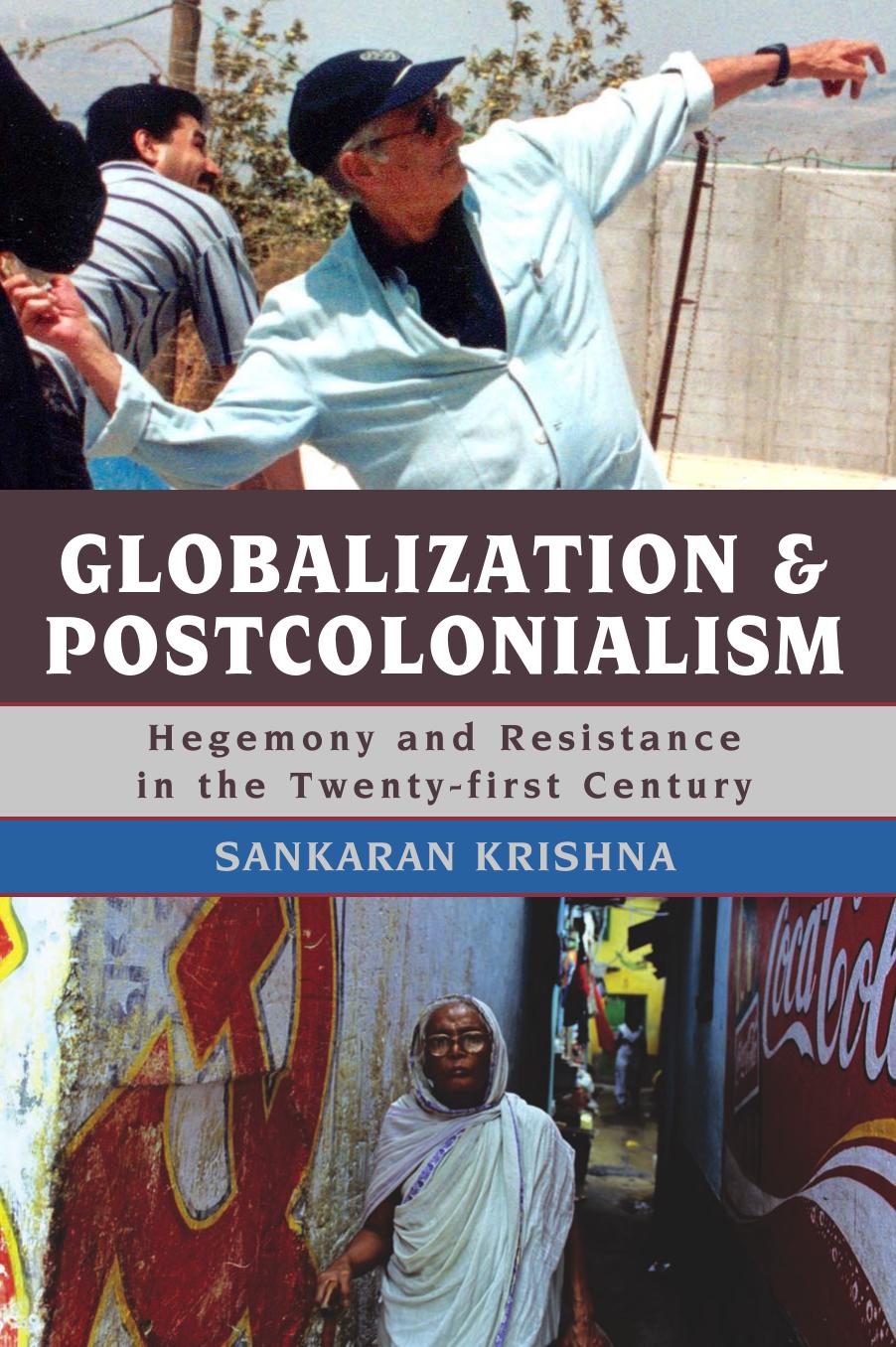
Author:Sankaran Krishna [Krishna, Sankaran]
Language: eng
Format: epub, pdf
ISBN: 9780742557642
Publisher: Rowman & Littlefield Publishers
Published: 2008-12-15T18:30:00+00:00
POSTCOLONIAL THEORY AS MELANCHOLIA
David Scott has recently argued that postcolonial theory has lost much of its relevance because the questions it once sought to answer are no longer the key questions. According to him, postcolonial thought emerged in the aftermath of the hopes and idealism of the anticolonial movements of the postâWorld War II decades and coincided with the rise of interpretive rather than positivist methods in social inquiry. It effectively demonstrated the limits of conventional anticolonial thought, especially those variants that saw in political decolonization and nationalism the answer to all the problems of the third world. The crucial point about postcolonial studies was that ideas such as antiessentialism, the critique of teleology, and the demonstration of the epistemic continuities between Western nationalism and anticolonial nationalist thought contributed to a richer understanding of the limitations of third-world national movements and of decolonization.25
However, once such insights were achieved, Scott argues, postcolonial thought transitioned from âcriticism to methodâ and became, as it were, the deployment of ideas such as antiessentialism, the critique of teleology, the ambivalence that informed colonial encounters, and the nuances that governed their relations, to more and more historical instances. In other words, the same methods were used to generate similar insights, but in newer historical and geographical contexts. Scott analogizes this to the conduct of ânormal scienceâ in Thomas Kuhnâs termsâthat is an incremental and predictable extension of findings to newer domainsârather than ârevolutionary scienceâ in the sense of a radically new way of seeing and conceptualizing things. In large part, the sense of diminishing relevance that characterizes the field of postcolonial theory, in Scottâs view, is due to the fact that it has lost sight of the political point of its scholarship. What, ultimately, animates our study? What is it that we wish to change in the world out there through our inquiry? Scottâs phrasing of these concerns is:
[H]ow colonialism ought to be understood for the present we live in has always to be a question we formulate and argue out rather than something we generate abstractly on the basis of theoretical inclusiveness or ethnographic broadmindedness. It seems to me that unless we persistently ask what the point is of our investigations of colonialism for the postcolonial present, what the question is to which we are fashioning an answer, what the argument is in which we are making a move and staking a claim, unless we systematically make this part of our strategy of inquiry, we are only too likely to slide from a criticism of the present to ânormalâ social science.26
I read Scott as arguing that postcolonial theory has to redefine for itself the political point of its scholarship. What is it there for? If the answer is âto constantly refine and nuance our understandings of past colonial encounters,â that will push it in a certain direction, one that Scott sees as having only a limited utility. However, if the answer is that the point of postcolonial scholarship is a criticism of the present, then
Download
Globalization and Postcolonialism by Sankaran Krishna.pdf
This site does not store any files on its server. We only index and link to content provided by other sites. Please contact the content providers to delete copyright contents if any and email us, we'll remove relevant links or contents immediately.
| Anthropology | Archaeology |
| Philosophy | Politics & Government |
| Social Sciences | Sociology |
| Women's Studies |
Cecilia; Or, Memoirs of an Heiress — Volume 1 by Fanny Burney(32558)
The Great Music City by Andrea Baker(32018)
Cecilia; Or, Memoirs of an Heiress — Volume 2 by Fanny Burney(31956)
Cecilia; Or, Memoirs of an Heiress — Volume 3 by Fanny Burney(31941)
We're Going to Need More Wine by Gabrielle Union(19045)
All the Missing Girls by Megan Miranda(16023)
Pimp by Iceberg Slim(14506)
For the Love of Europe by Rick Steves(14121)
Bombshells: Glamour Girls of a Lifetime by Sullivan Steve(14073)
Talking to Strangers by Malcolm Gladwell(13370)
Norse Mythology by Gaiman Neil(13363)
Fifty Shades Freed by E L James(13239)
Mindhunter: Inside the FBI's Elite Serial Crime Unit by John E. Douglas & Mark Olshaker(9339)
Crazy Rich Asians by Kevin Kwan(9290)
The Lost Art of Listening by Michael P. Nichols(7506)
Enlightenment Now: The Case for Reason, Science, Humanism, and Progress by Steven Pinker(7311)
The Four Agreements by Don Miguel Ruiz(6763)
Bad Blood by John Carreyrou(6621)
Weapons of Math Destruction by Cathy O'Neil(6279)
